

Crowd Clash: Run Master
Universe Game Labs
When I tried Crowd Clash: Run Master, the idea that stayed with me was not simply running forward. The game turns crowd size into the main tool for overcoming obstacles and rival groups, so every short attempt becomes a quick decision about growth, risk, and timing. It is a free racing game from Universe Game Labs, rated for Everyone, and it fits the kind of session I can start while waiting for a bus or taking a short break.
The central appeal is easy to understand: move through the course, build a larger crowd, and use that advantage to overpower opposing crowds. That sounds straightforward, but the emphasis changes how I read the track. I am not only asking which direction is safest. I am also judging whether a route is worth taking because it may leave me strong enough for the next confrontation. The crowd is both my score of progress and my practical protection.
That single capability gives the game a clear identity within casual racing. It is less about realistic driving lines or vehicle tuning and more about making fast choices while the course keeps moving. If you enjoy compact games where the rules are understood almost immediately, this is an inviting starting point. If you want deep car handling, long championships, or a simulation of motorsport, this is probably aimed at a different mood.
Turning a simple run into a crowd-management challenge
The crowd mechanic is the real center of the game
In a usual endless runner, I tend to think about survival first: avoid hazards, stay on the path, and continue for as long as possible. Here, the running action has another layer. The size of my group affects how confidently I can approach an enemy crowd. A route that looks slightly awkward may still be the better choice if it helps me arrive at the next clash with more people behind me.
That makes the game feel closer to a moving resource puzzle than a conventional race. I am constantly converting movement into strength. The important question is not only “Can I get there?” but “What will I have left when I get there?” This is a useful distinction because it gives ordinary steering decisions a consequence beyond immediate survival.
Related News






I also like that the premise remains readable without a long explanation. The store summary describes running, counting, and overpowering enemy crowds, and the play experience follows that idea closely. There is no need to learn a large collection of controls before understanding the objective. That accessibility suits the Everyone content rating and makes the game easy to hand to a younger player or someone who rarely plays mobile games.
Why route choice matters more than speed alone
The temptation in a racing game is to treat the fastest-looking line as automatically correct. Crowd Clash: Run Master made me more cautious. A narrow advantage in distance can be less valuable than arriving with a healthier group. When I rushed toward an apparent shortcut without considering what it would cost, the next enemy encounter became much less forgiving.
My practical advice is to judge each section in two stages. First, look at the immediate movement problem. Then, before committing, think about the condition of the crowd after that choice. This habit is more useful than trying to react at the last possible moment. It also gives the game a small but satisfying layer of planning, even though individual runs remain quick and approachable.
Gallery
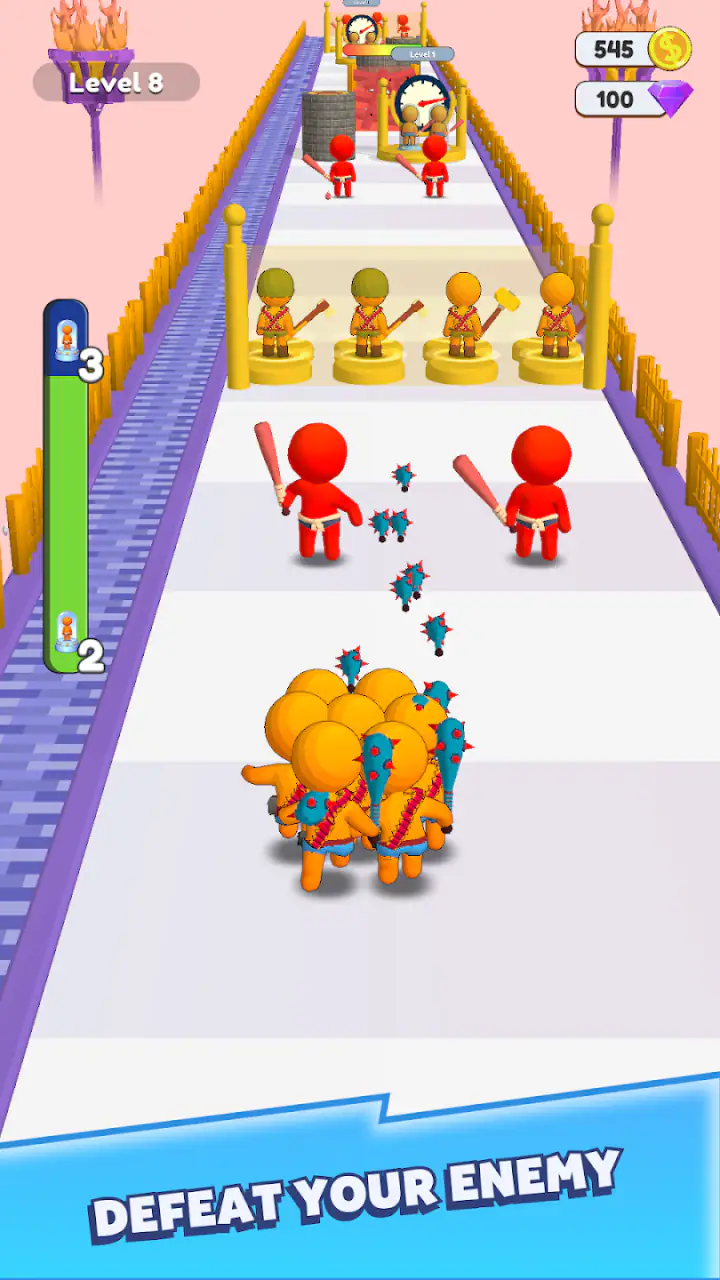
Another useful adjustment is to stop treating every available opportunity as mandatory. More growth is attractive, but a route that forces awkward movement may create a larger problem than it solves. I found better results when I chose a stable line and protected the group I already had instead of chasing every possible increase. That is a non-obvious trade-off for such a simple-looking runner: the best decision is often the one that preserves options rather than the one that promises the biggest immediate gain.
How the game feels in short sessions
The format works well for brief play. I can make a few attempts, notice where my decision went wrong, and try again without needing to remember a complicated build or a long campaign. That quick reset is important because the game’s appeal comes from repeating a compact challenge and refining judgment.
It also means the experience depends heavily on whether you enjoy retrying similar situations. Players who like gradually improving their route choices should find a natural loop here. Players who need a strong narrative, detailed progression, or a changing competitive structure may find the repetition too light. The game’s strength is immediacy, not breadth.
What I would do during an everyday break
My favorite use case is a short waiting period when I want something more active than scrolling but do not want to commit to a full racing event. I would start a run, focus on keeping the crowd healthy through the opening decisions, and use the final moments to see whether my earlier choices had created enough strength for the confrontation ahead. If I fail, I can identify one decision to change instead of feeling that I have lost a large amount of progress.
That makes it suitable for a commute or a few minutes before an appointment, provided the player is comfortable with a game that may encourage “one more attempt.” I would not choose it when I need a quiet, uninterrupted activity, because the value comes from watching the route and responding quickly rather than letting the game run in the background.
Where it stands beside other mobile racing games
Compared with kart racers, this game puts much less weight on vehicle identity, drifting, weapons, and head-to-head driving technique. Compared with endless runners, it gives the run a more visible strategic objective because crowd strength influences how I approach enemies. Compared with large racing games, it is far easier to pick up, but it does not offer the same sense of mastery through vehicle setup or track knowledge.
I would choose a traditional arcade racer when I want the feeling of controlling a car and competing through corners. I would choose a more elaborate runner when I want character development or a wider set of long-term goals. I choose this one when I want a compact crowd-versus-crowd challenge in which route decisions matter immediately.
Practical details before installing
The game is free to download, with optional in-app purchases ranging from $0.99 to $99.99 per item. That price range is worth keeping in mind before handing the device to a child, even though the content rating is Everyone. I would review purchase settings on the device first, especially if the game is being used by a younger player.
It runs on Android 7.1 or later, which makes it accessible on a broad range of older compatible devices. The current version is 1.2.6. The developer is Universe Game Labs, and the game has reached over 100K installs with a 4.2 average from around 3.2K ratings. Those figures suggest that it has found an audience, though I would still judge it by the kind of racing experience I actually want rather than by popularity alone.
The strongest scenario: choosing survival over spectacle
The game is at its best when I enter a section with enough time to make a deliberate choice. I can look at the available paths, estimate which one will protect the crowd, and then approach the enemy group with a plan instead of simply reacting. In that situation, the central mechanic feels meaningful because the crowd I built earlier directly affects what I can attempt now.
This is also where the game can teach a useful habit: do not spend a resource merely because it is available. In this case, the resource is the size of the group. Preserving it can be more valuable than taking a risky route for a temporary advantage. That lesson is simple, but it gives repeated attempts a purpose. I am not only trying to move faster; I am trying to understand which decisions create a reliable run.
For a younger player, this may be a gentle introduction to planning under pressure. For an adult player, it works as a low-commitment test of attention and timing. I would especially recommend it to someone who likes games where a single rule produces several small decisions rather than games overloaded with menus and systems.
Where the experience can lose momentum
The same simplicity that makes the game approachable can also limit its staying power. If I am looking for a broad selection of cars, detailed tracks, or a campaign that changes dramatically over time, the crowd-running format may feel narrow. The game asks me to improve my handling of its central loop, not to explore a large racing world.
There is also a possible frustration in the relationship between movement and crowd preservation. A mistake early in a run can make later encounters feel decided before they arrive. That is not necessarily a flaw; it is the natural consequence of making crowd size important. Still, players who prefer forgiving races may dislike having to restart after a poor opening choice.
The free-to-play structure deserves a measured approach as well. Since individual purchases can be substantial at the upper end of the listed range, I would avoid assuming that free access means every player will experience the game in exactly the same way. I would play the basic loop first, decide whether it is genuinely enjoyable, and only then consider spending. For me, the core decision-making must be fun without pressure, otherwise purchases will not solve the underlying issue.
Three habits that make the central mechanic more enjoyable
Protect the crowd before chasing a shortcut. A route that looks exciting is not automatically valuable if it leaves the group too weak for the next enemy encounter.
Review the decision before blaming the controls. After a failed run, I ask whether I chose the wrong path or committed too late. This separates a planning mistake from a movement mistake and makes retries more productive.
Use short sessions to test one change at a time. Changing the opening route, then the approach to the first enemy group, gives clearer feedback than changing everything on every attempt.
These habits are more useful than trying to play every run aggressively. The game rewards attention to the relationship between present movement and future crowd strength. Once I started thinking in that sequence, the experience became less like tapping through a simple course and more like managing a small, moving advantage.
Who should give it a try
I think the best audience is someone who wants a free, accessible racing game with a clear gimmick and short attempts. It is a good fit for players who enjoy quick decisions, visible consequences, and the satisfaction of improving after a failed run. It can also work for families looking for an easy-to-understand game, although I would still keep the purchase settings in mind.
I would skip it if your priority is realistic racing, online competition, advanced car customization, or a deep progression system. Those expectations point toward a more traditional racing title. I would also skip it if repeated runs feel like busywork to you; the game’s value comes from refining the same basic idea rather than constantly unlocking a new genre of activity.
My recommendation after spending time with it
Crowd Clash: Run Master succeeds because it gives one simple question enough weight to carry the whole run: how large and healthy can I keep my crowd before the next clash? That focus makes the game easy to understand but not entirely mindless. Route choice, conservation, and timing all matter because they determine whether my group can overcome what is ahead.
It is not a replacement for a full arcade racer, and it should not be judged by the standards of a driving simulator. Its appeal is narrower and more immediate. I would recommend it to a friend who wants a quick mobile challenge that sits between an endless runner and a lightweight racing game, especially when there are only a few minutes to play.
My final advice is to approach it as a decision game with racing movement, not as a conventional race. Keep the crowd intact, think one encounter ahead, and treat each retry as a chance to test a specific choice. With that mindset, the compact design works in its favor. Without it, the experience may seem too repetitive. For the right player, though, the crowd mechanic gives this small free game a distinct reason to stay installed.
FAQs for Crowd Clash: Run Master
What is Crowd Clash: Run Master?
Crowd Clash: Run Master is a casual arcade game centered on running through obstacle-filled levels while building and controlling a larger crowd. As you move forward, you typically collect characters, choose helpful gates, avoid hazards, and face an end-of-level challenge. The gameplay is designed to be easy to understand, with short stages that suit quick sessions on Android or iOS.
How do you play Crowd Clash: Run Master?
The main controls are generally simple, relying on swipes, taps, or directional movement to guide your runner along the course. You need to position the crowd carefully, pass through gates that increase its size or strength, and avoid traps that reduce your numbers. At the finish, the remaining crowd is used to overcome an opponent or complete the final objective.
Is Crowd Clash: Run Master free to download and play?
Crowd Clash: Run Master is commonly offered as a free download, allowing players to start without paying an upfront purchase price. However, the game may include advertising, optional in-app purchases, or other monetization features. Before downloading, it is worth checking the store listing for the current pricing details, supported devices, and whether purchases can remove ads or provide gameplay-related bonuses.
Does Crowd Clash: Run Master require an internet connection?
The basic running levels may be playable without a constant internet connection, which makes the game convenient for travel or short offline sessions. Nevertheless, some features can depend on connectivity, including advertisements, rewards, updates, analytics, or online events. Availability may also vary between versions, so you should test the installed game in airplane mode rather than assuming every feature works offline.
Is Crowd Clash: Run Master suitable for children?
Crowd Clash: Run Master uses simple arcade mechanics and cartoon-style action, so it can be approachable for younger players who understand basic movement and obstacle avoidance. Even so, parents should review the age rating, advertising content, and in-app purchase settings before handing over the device. The game may also become repetitive, and some stages can include fast reactions or frustrating difficulty increases.
Pros
- Simple controls make the game easy to pick up quickly.
- Short levels are convenient for quick gaming sessions.
- Colorful visuals give the gameplay a lively
- casual feel.
- Collecting larger crowds creates satisfying progress during runs.
- The game works well for players seeking a relaxed arcade experience.
Cons
- Repeated level patterns can make the gameplay feel predictable over time.
- Frequent ads may interrupt the flow between or during levels.
- Some upgrades may feel slow without optional purchases or ad views.
- Crowd movement can be imprecise in narrow sections of a course.
- The game may offer limited long-term depth for experienced players.


